
History
Our story is more than seventy years of military hockey in Zweibrücken, from the Royal Canadian Air Force Flyers of 1953, through CANUSA, the Warriors and the Ramstein Rams, to the KMC Eagles of today.
1953The beginning: RCAF 3 Wing Flyers
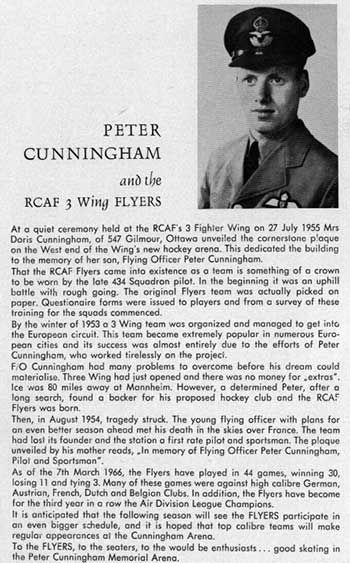
Our military ice hockey organization has been around in one form or another since the 1950s, starting as the Royal Canadian Air Force (RCAF) 3 Wing Flyers out of Zweibrücken Air Base.
The Flyers came into being in 1953 through the untiring efforts of F/O Peter Cunningham. This sportsman Flyer, with the generous financial backing of a Dr. Krantz in Munich, founded the first Air Division hockey team. As 3 Wing had no ice arena in those days, the home games were played in Munich. Pete Cunningham lost his life in a flying accident in 1954; his team lived on.
From a modest beginning it grew into the RCAF Flyers Europe, a picked team of the best hockey players in the Air Division. When Dr. Krantz could no longer carry the financial burden, 3 Wing took over and ice time was obtained at Mannheim.
1956The golden years
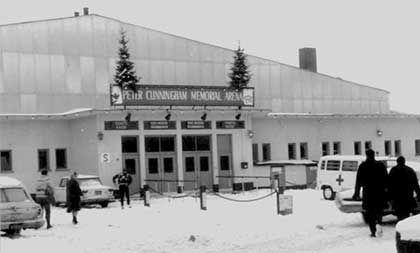
In January 1956 the base arena opened and was named after the Flyers’ founder. From then on the Flyers made a name for themselves in European hockey circles. Known all across the continent as Canada’s skating ambassadors, they played in the first German league and took on the national teams of Canada, the United States, Germany and Italy, as well as the leading teams from the Scandinavian countries.
1960The 3 Wing Flyers carry on
By 1960 the other wings in the Air Division had arenas of their own and, understandably, were loath to give up their hockey players to 3 Wing. With that supply of talent gone, the RCAF Flyers Europe ceased to be and the 3 Wing Flyers took over. Even so, they remained formidable opposition and much in demand as opponents across Europe.
The Flyers account is taken from the former Flyers alumni site (goflyersgo.ning.com). The photographs of the Flyers era were provided by Armin Karcher.
1979CANUSA and the USA Ambassadors
After most of the Canadians departed Zweibrücken, the American military took responsibility for the base, including the ice rink, and the team was renamed CANUSA. It expanded its friendly games to teams in and around Paris.
Mike Mamer, who still played for the Eagles decades later, recalls playing for CANUSA in 1979: a combined team of American and Canadian players at the Zweibrücken Air Base rink, playing friendlies throughout Germany and Luxembourg, especially against Canadian teams at other NATO locations such as Baden-Baden and Lahr.
“I played from 1979 to 1982 with Mike Mamer. We played from 79–80 for CANUSA, made up of American and Canadian Forces. From 1980 to 1982 I played out of Zweibrücken with the team under the name of the USA Ambassadors. We competed against the Canadian base teams in Lahr and Baden-Baden, German teams, French teams, the Luxembourg and Belgian national teams. Only lost a handful of games over the course of three years. I do remember Mamer planning the trip to Denmark to play hockey, only to find out later it was a field hockey tournament.”
Joe Kirchner
1988The Warriors
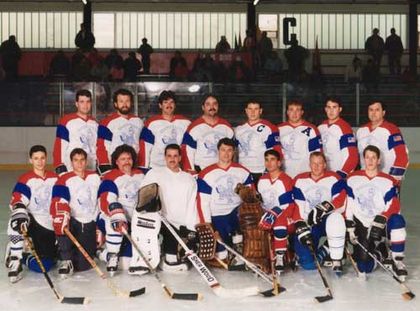
Benny King played for the team from 1988 to 1993, when they were known as the Warriors. They were much the same mix of active duty and civilians as today’s club. They started out against teams from Bitburg and Spangdahlem and local German sides from Kaiserslautern and Mannheim, and played home and away against the squadron teams at the two Canadian bases, Lahr and Baden-Baden.
1989Into the German league
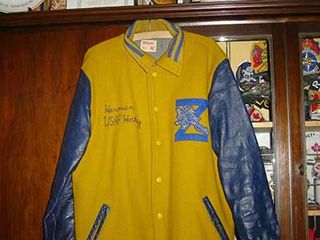
The Warriors joined the German league in 1989, played the first year in the Landesliga and beat every German team in it. Promoted to the Regionalliga, they played some good games. After the Canadians left Zweibrücken in 1991, the team’s activity declined considerably: the bar that sponsored the team closed and only a few players came in from Ramstein and Kaiserslautern.
2001Ramstein Rams
In 2001 the team was renamed the Ramstein Rams, led by John Hoffman and Frank Barker, playing pickup and friendly games around Germany.
2004KMC Eagles
In 2004, under the new leadership of Tom Duggan, the name changed to the KMC Eagles to encompass the Kaiserslautern Military Community of 50,000 U.S. and NATO military personnel and host nationals. The team averaged about twenty players a season and welcomed every skill level to help offset the cost of running an ice hockey organization.
Expanding beyond friendly games, the Eagles were invited into a newly formed German league, Die Players Liga (DPL), managed by an American educator, Ken Robinson. The league had eight teams. With only one goalie, the Eagles struggled all season to keep a roster strong enough to compete, averaging nine or ten players a game.
2005Todd builds the family
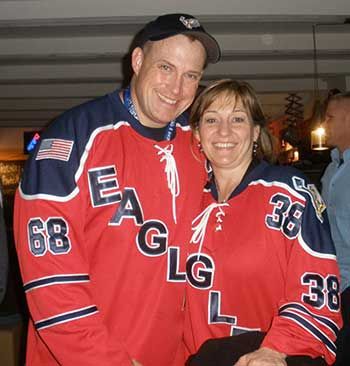
In 2005 Tom Duggan was scheduled to deploy and would miss the start of the season. The old-timers nominated Todd Poynter to take the reins: a novice player, but connected to the NHL through his father, Anthony “Tony” Mancuso. With the support of his wife Paulette and his family, Todd took the position of president.
Knowing the team needed new players, Todd marketed the Eagles aggressively to the community to replace those returning to the United States. At the first practice about 47 new players were on the ice, rounding the four corners of the rink during drills, and high slap shots over the net were a concern. Coach Paul Hilfer, a former academy team captain, worried about finding enough ice time for games and practices, a problem Todd would solve the following year. A highlight of that season was a 15–0 win over the Luxembourg national team at an end-of-season tournament.
In the DPL’s second year the Eagles won the cup, with a roster that included Mamer, Hilfer, Tommy Duggan, Ryan Argenta, Jason Grey, Merrill “Slep” Slepica and John Lane.
2007A second team
In 2007 Todd created a second team, the KMC Adlers (“Eagles” in German). Both teams entered the DPL and the USAFE Armed Forces tournament, an annual military event by then in its fifteenth year. Tom Duggan returned from deployment to help coach John Nagy manage the Eagles, who placed second at the USAFE tournament, the club’s best result to that point. The Adlers, led by Scott Smith, placed eighth.
By 2008 the organization’s email list had grown past ninety players. Under coach Phil Forward and assistant coach Tony Mancuso the Eagles again placed second at the USAFE tournament; the Adlers placed eighth again, with more goals scored than the year before.
2009Tradition of excellence
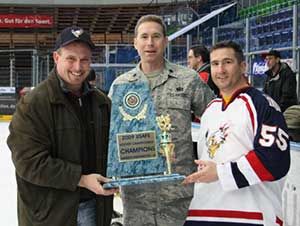
In 2009 player-coach Brian O’Connor took the Eagles to a banner year: the DPL championship against the arch-rival Baden Bruins, the DPL Harder Cup, the Prague New Year tournament and, most importantly, the club’s first USAFE Armed Forces championship.
The Adlers, managed by Mike Mamer and later in the season by Parker Hamilton, developed like a young Eagles team, placing sixth at USAFE and winning numerous friendly and league games. A season highlight was the Eagles playing the German second-league Zweibrücken Hornets in front of more than 450 paying fans and professional photographers.
2011A1C Zachary Cuddeback
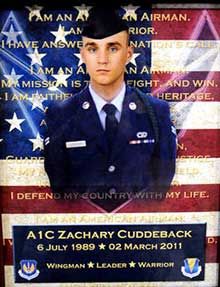
On the morning after practice on 2 March 2011 the club lost an Eagle. A1C Zachary “Cudde” Cuddeback was killed in a terrorist shooting at Frankfurt Airport. His memory lives on in the organization: the Eagles proudly wave his memorial banner after championships, and since 2013 have played their own tournament in his name, the Cuddeback Memorial Cup, every autumn.

Zac will forever be a model Airman and Eagle. Read the memorial page.
2012“The Red” takes the reins
In spring 2012, after nearly a decade of dedication, Todd Poynter stepped down and handed the presidency to Eric “the Red” Helgeson. A new website was designed, but the spirit of the hockey family did not change.
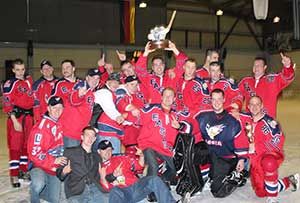
Division I DPL champions
Battling through a season of deployments, TDYs, injuries and PCS moves, Eagles I climbed from fourth seed to the Division I championship game, going the full three games in both playoff rounds before facing the defending champions, the Heddesheim Flames. The Eagles led 6–1 at one point and Heddesheim fought back, but the Eagles won 10–7 and returned to Moloney’s Irish Pub in Kaiserslautern as champions.
The KMCC recruiting booth
In the summer the club set up a recruiting stand in the KMCC mall on Ramstein and convinced around twenty people that they could still play hockey, taking the active roster past seventy.
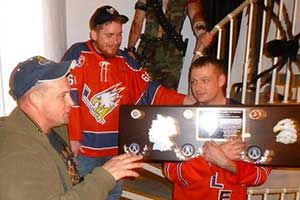
The first retired number: No. 68
As the 2012–13 season began, Eric wanted to recognize the “MVP of the Eagles family” at once. In front of around thirty Eagles, family and friends, the leadership presented Todd and Paulette Poynter with a plaque and officially retired number 68. Mounted on the plaque, donated by players, were all four USAFE championship pucks Todd earned during his tenure. Their contributions will never be forgotten.
2013Saving the tournament, and a fifth title in a row
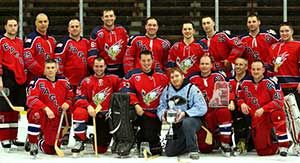
The Eagles showed their strength in leadership when a last-minute fiscal crisis left USAFE without funding for the Garmisch tournament. The club stepped up, raised around $9,000, organized the ice times and coordinated referees and rink managers in less than two weeks. The eleven-team military tournament was a success, and the Eagles won their fifth Armed Forces Europe championship in a row.
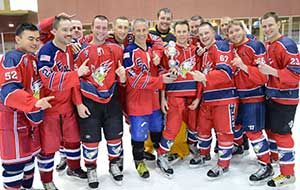
Hockey North America Europe champions
In March 2013 two Eagles teams, drawn from all three of the club’s sides, played the annual Zoetermeer tournament near Amsterdam. Eagles I lost 7–2 to a French team in the opening game, later beat the same team 4–2 and were crowned 2013 Division I champions.
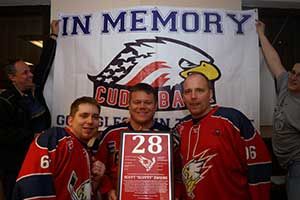
The second retired number: No. 28
At the end-of-season party at De Belgian Bistro, filled with more than sixty Eagles, the club surprised one of its most respected players. On 20 April 2013 number 28 was officially retired for Scott “Scotty” Zwiers: 2009 and 2012 DPL champion, 2009–2012 USAFE champion, two-time USAFE MVP and 2011–12 Zweibrücken champion, alongside everything he contributed off the ice.
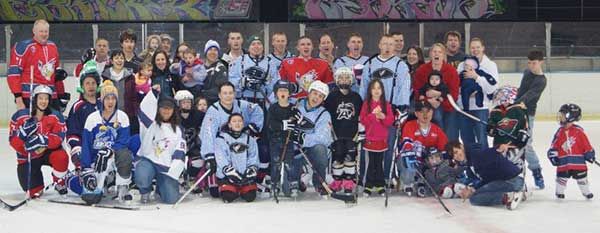
Thank you
In the 2012–13 ice season the organization ran 52 practices, played more than 52 league and friendly games and five tournaments in three European countries. The players who took on key roles, offered help and played whenever and wherever they were needed made the club strong. The season’s success owed much to the players’ partners and families too: late games and practices, travel to other countries, out-of-pocket costs for equipment and hotels, and support from cold rink stands.
SinceOnce an Eagle, always an Eagle
The Armed Forces tournament we rescued in 2013 lives on as the Armed Forces Alpine Classic in Garmisch, which we won again in 2015, 2016, 2022, 2023 and 2024. In 2024 we added another Division I DPL championship in Eppelheim. Today our teams play in the DPL, in friendly games and in tournaments across Europe, and we’re still open to every branch, every skill level and anyone in the community who can skate. You’ll find every title under Heritage and honors.
“We look forward to another exciting and challenging year with many of the old-timers moving on during the summer. Contact us if you would like to add more historical events or facts to the webpage. Once an Eagle… always an Eagle! GO EAGLES!”
Have a correction, a photo or a story to add? Tell us.